

Have you ever been mid-lift in the gym, only to once again be interrupted by that annoying pinch in your shoulder?
Maybe it happens during a bench press, overhead press, lateral raise or even reaching behind your back. You might have tried changing your technique, dropping the weight or simply pushing through it, only for the pain to keep coming back.
Shoulder pain while lifting can be a result of a number of different causes. Changes in training load, strength, shoulder movement, previous injuries and even factors such as sleep and recovery can all play a role.
Understanding what may be contributing to your shoulder pain is an important first step in managing your symptoms. Here are some common factors a physiotherapist may consider when assessing shoulder pain during gym exercises:
Rotator Cuff
The rotator cuff is a group of muscles that help control and stabilise the shoulder during movement. Rotator cuff-related pain can develop when the demands placed on the shoulder increase faster than your capacity to handle them.
This can happen after increasing your weights, training volume or frequency, introducing new exercises or returning to the gym after a break.
Common concerns include a ‘pinching’ sensation during a chest or shoulder press, or a dull ache immediately following exercise.
It doesn't necessarily mean you've damaged something. Sometimes your shoulder simply needs time and appropriate loading to build its capacity back up.
The below image is a good representation of some of the rotator cuff muscles, seen from the back. These muscles assist in the movements mentioned earlier, and can be underprepared for increases in volume or load.
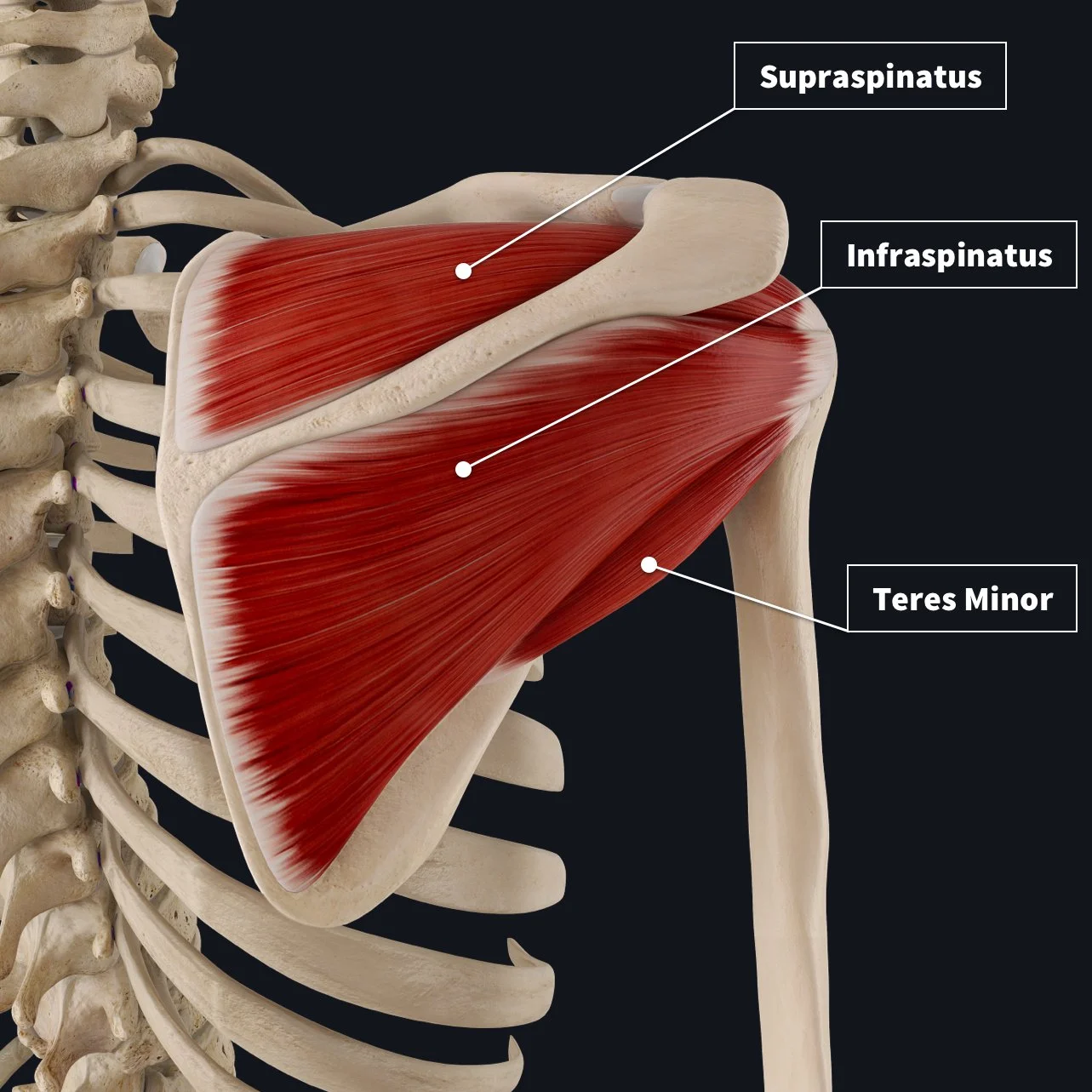
Muscles of the Rotator Cuff, seen from the back.
Scapular Movement
Your shoulder blade (scapula) plays an important role in allowing your shoulder to move efficiently, particularly during pressing, pulling and overhead exercises.
Changes in the strength or coordination of the muscles controlling the scapula may contribute to shoulder pain in some people. However, there isn't one "perfect" shoulder blade position that everyone needs to achieve.
A physiotherapist can assess how your shoulder and scapula are moving together and whether this is actually contributing to your symptoms.
Training Load
Sometimes the exercise itself isn't the problem, it's how much you're currently asking your shoulder to do.
A sudden increase in weight, training volume or frequency can place more stress on the shoulder than it is used to. Poor sleep, stress and inadequate recovery can also affect how well you tolerate training.
This doesn't mean you need to stop going to the gym. Often, making a few temporary adjustments to your training can allow you to keep exercising while your shoulder settles and gets stronger.
Does This Mean I Should Stop Lifting?
Not necessarily.
For many shoulder problems, you don't need to stop exercising completely. Modifying your weight, range of motion or exercise selection can help manage symptoms while gradually rebuilding shoulder strength and capacity.
Research supports exercise as an effective treatment for rotator cuff-related shoulder pain, with no single exercise proving superior (Tena-Portilla et al. 2026)
How Heathmont’s Physiotherapists Can Help:
Your physiotherapist can assess your shoulder movement, strength, rotator cuff function, neck and training history to work out what may be contributing to your symptoms.
Treatment may include targeted strengthening, modifying your gym program, manual therapy where appropriate, and gradually increasing your shoulder's tolerance to load.
If that familiar shoulder pinch keeps coming back every time you train, don't just keep pushing through it and hoping it disappears.
If shoulder pain is affecting your training or making certain exercises difficult, book an appointment with a physiotherapist at Heathmont Physio & Sports Medicine.
Our team can help identify what's contributing to your symptoms and get you back to training with a plan that suits you!
https://book.nookal.com/bookings/book/08b79DE2-5eb6-0ec3-C96B-aaff37D65ad5/location/ECALY
1. Tena-Portilla, A., Martín-San Agustín, R., Gacto-Sánchez, M., & Escriche-Escuder, A. (2026). Effectiveness of exercise in rotator cuff-related shoulder pain: a systematic review with meta-analysis. Physiotherapy Theory and Practice, 1–30. https://doi.org/10.1080/09593985.2026.2717392